
Last updated July 10, 2026
How to Hire a Air Duct Cleaning Contractor in Akron: A Step-by-Step Guide
That $99 whole-house duct cleaning advertised on Groupon? It’s perfectly legal in Ohio — because virtually nothing about this trade is regulated. No state license, no mandatory certification, no equipment standard. Your only protection is knowing what to ask before anyone opens a register in your Akron home. After 11 years crawling through duct systems across Summit County — from Firestone Park to Goodyear Heights to the historic homes near Highland Square — we’ve seen what separates a legitimate specialist from a coupon-mailer operation that blows dust around and invoices you for “surprise” upsells. This guide gives you the exact questions, equipment red flags, and job-site behaviors that protect your money and your air quality.
Quick Answer
Hiring a qualified air duct cleaning contractor in Akron means verifying three things: they use named professional equipment (Rotobrush, Nikro, or equivalent truck-mounted systems), they quote by system scope rather than per-vent gimmicks, and the person diagnosing your ductwork is the same person doing the work — not a rotating crew dispatched from a call center. Ask for before/after photos from inside your actual ducts, confirm they clean the blower compartment and return plenum (not just visible vents), and get every line item in writing before booking.
Table of Contents
- Why Ohio’s Unregulated Duct-Cleaning Market Puts the Burden on You
- The Three Equipment Questions That Filter Out 80% of Bad Actors
- What NADCA Membership Actually Means — And What It Doesn’t
- How to Read an Estimate Line by Line: Legitimate Add-Ons vs. Upsell Pressure
- Job-Scope Red Flags: Per-Vent Pricing, Skipped Components, and Missing Documentation
- Why Sending the Owner Matters: Diagnostic Continuity and Accountability
- Akron-Specific Considerations: Climate, Housing Stock, and Local Risks
- Common Mistakes to Avoid
- When to Call a Professional
- Frequently Asked Questions
- The Bottom Line
Why Ohio’s Unregulated Duct-Cleaning Market Puts the Burden on You
Here’s what surprises most Akron homeowners: the person cleaning your ducts doesn’t need a license specific to this trade. Ohio requires no state certification for air duct cleaning. A general business license and liability insurance are the only legal barriers to entry. That $99 Groupon special? It can be run by someone who bought a shop vacuum yesterday and printed business cards this morning.
This regulatory gap creates two problems for consumers in Summit County. First, there’s no recourse board to complain to about shoddy work — your dispute becomes a civil matter, not a professional licensing issue. Second, the low barrier attracts fly-by-night operators who cycle through neighborhoods with seasonal postcard campaigns, perform superficial cleanings, and disappear before callbacks accumulate.
We’ve responded to dozens of homes in Akron’s Ellet, North Hill, and West Akron neighborhoods where a “cheap clean” left the system worse than before — agitated debris blown past filters, access panels left unsecured, flex duct crushed by careless agitation tools. In one 1920s Tudor near Merriman Valley, a previous contractor’s compressed-air “cleaning” lodged a decade of fireplace soot deeper into the trunk line, requiring full duct repair and sealing to restore airflow.
The practical implication: every vetting step in this guide is your responsibility because no state agency has done it for you.
The Three Equipment Questions That Filter Out 80% of Bad Actors
Equipment specificity is where commodity operators immediately reveal themselves. Ask these three questions on your initial call, and note whether you get brand names, vague adjectives, or deflection.
Question 1: “What brand and model of duct-cleaning equipment do you use?”
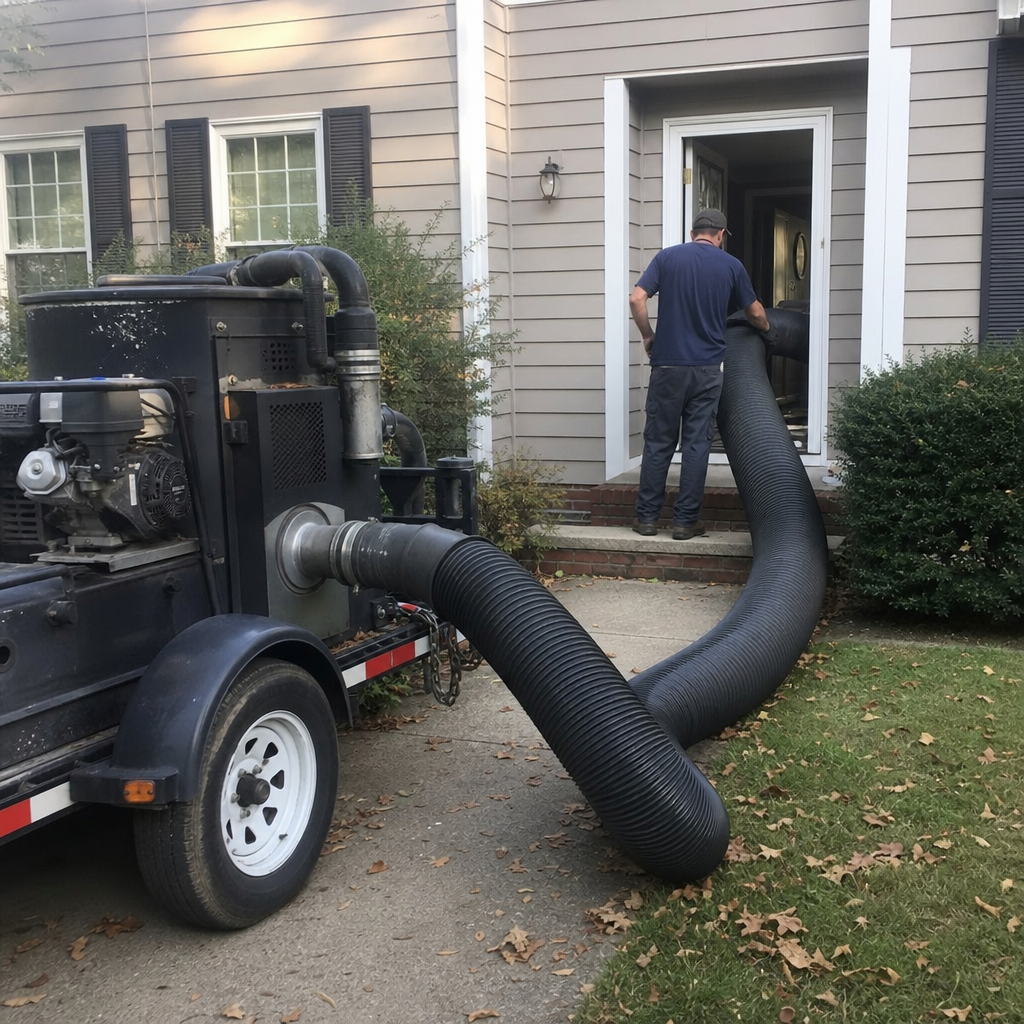
Legitimate answers include specific names: Rotobrush (beast-series brush systems), Nikro (truck-mounted or portable HEPA-collection units), or equivalent commercial-grade systems from Abatement Technologies. Red-flag responses include “professional-grade equipment” (no brand named), “industrial-strength vacuums” (could mean a Shop-Vac), or “the same equipment the big companies use” (evasion).
Why this matters: brush-and-vacuum systems like Rotobrush physically contact duct walls to dislodge adhered debris, while HEPA-collection systems like Nikro prevent contamination of your living space during extraction. Hardware-store vacuums and rental carpet-cleaner attachments — common in low-price operations — lack the suction power and containment to capture fine particulate, especially the pollen, skin cells, and construction dust that accumulate in Akron’s older housing stock.
Question 2: “Do you use negative air pressure or contact cleaning — and for which duct types?”
Competent contractors explain their method by duct material. Rigid metal trunk lines in pre-1970 Akron homes typically need contact brushing (Rotobrush-style) to break adhered deposits. Flex duct common in 1980s–2000s construction requires gentler negative-air extraction to avoid damaging the inner lining. A contractor who uses one method for everything doesn’t understand duct systems — or doesn’t care about damage.
Question 3: “What containment and filtration do you use during cleaning?”
Professional-grade jobs use HEPA filtration on collection units and physical containment at registers. Abatement Technologies and equivalent systems prevent the “cleaning” from becoming a dust storm in your living room. Ask specifically: “Do you seal off registers during cleaning?” and “What MERV rating is your collection filter?” Answers below HEPA (99.97% at 0.3 microns) or evasion on register sealing indicate inadequate containment.
At Elite Air Duct Cleaning Service Greater Akron home, Matthew handles this job personally with Rotobrush and Nikro systems, paired with Abatement Technologies containment — not because it’s marketable, but because 11 years of seeing what inadequate equipment leaves behind has made the alternative unacceptable.
What NADCA Membership Actually Means — And What It Doesn’t
The National Air Duct Cleaners Association (NADCA) is frequently cited as a trust signal. Here’s the precise reality for Akron homeowners evaluating this credential.
What NADCA membership verifies: The company has paid annual dues, employs at least one technician who passed a written exam on HVAC system cleaning, and maintains general liability insurance. The exam covers industry standards (ACR, the NADCA Standard) for assessment, cleaning, and restoration of HVAC systems. Membership requires adherence to a code of ethics with a complaint process.
What NADCA membership does NOT verify: Hands-on quality of any specific job, equipment caliber, owner involvement, pricing transparency, or local reputation. A NADCA member can still dispatch untrained crews, use inadequate equipment, or employ aggressive upsell tactics. The credential is a floor — a basic professional baseline — not a ceiling guaranteeing excellence.
We’ve encountered NADCA-member companies in the Akron market whose “cleaning” consisted of 45 minutes of compressed-air blowing with no mechanical agitation, no blower compartment access, and no photographic documentation. The membership was current; the work was inadequate.
How to use NADCA membership in your vetting: Treat it as one data point among several. Verify current membership at nadca.com (members lapse), ask which specific technician holds the ASCS certification (Air Systems Cleaning Specialist), and confirm that certified technician will be on your job — not just employed by the company in a managerial role. Then still ask the equipment questions above and demand scope specifics below.
How to Read an Estimate Line by Line: Legitimate Add-Ons vs. Upsell Pressure
A proper estimate for Akron duct cleaning should itemize system components, not hide behind a single “whole house” number. Here’s how to distinguish legitimate scope expansion from pressure tactics.
| Line Item | Legitimate When… | Red Flag When… |
|---|---|---|
| Dryer vent cleaning | Offered as optional, priced separately ($75–$150 typical in Akron), with fire-risk explanation | Pushed as “required for warranty” or bundled opaquely |
| Coil cleaning (evaporator) | Recommended after visual inspection shows buildup; priced $100–$200 | Added after arrival with “your system needs this” without showing you |
| Sanitizing treatment | Named product (we use Guardsman-brand treatments with documented efficacy); optional; $50–$125 | “Mold treatment” scare tactic without lab verification; unnamed chemical |
| Duct sealing/repair | Proposed after camera inspection shows leaks; priced per linear foot or section | Suggested for “efficiency” without pressure-test or visual evidence |
| Register count charges | Never — legitimate pricing is per system or per square foot | Per-vent pricing ($X/register) with surprise “additional returns” fees |
The per-vent pricing model deserves special attention. We’ve seen Akron homeowners quoted $15 per supply register, then learn their system has 14 supplies and 4 returns, with returns priced at $25 each, plus “main trunk access” fees, plus “system complexity” surcharges. The $210 quote became $580 on the invoice. Legitimate estimates define the full system scope upfront: all supply branches, all return branches, trunk lines, plenums, and blower compartment as one integrated service.
At our company, Matthew provides upfront pricing by home size and system configuration — no per-vent games, no post-arrival surprises. The estimate you approve is the invoice you pay, unless we discover genuine issues (damaged ductwork, inaccessible components) that we document and discuss before any additional work.
Job-Scope Red Flags: Per-Vent Pricing, Skipped Components, and Missing Documentation
Beyond estimate structure, specific on-site behaviors separate thorough work from superficial cleaning. Watch for these five red flags during the job itself.
- They don’t access the blower compartment. The blower (air handler fan) is where the heaviest debris accumulates — it’s the system’s engine room. If technicians clean registers and trunk lines but never open the blower cabinet, they’ve skipped the component that most affects airflow and recontamination. In Akron’s climate, with heavy pollen seasons and winter furnace use, blower buildup is inevitable and must be addressed.
- They won’t show you before/after photos from inside your ducts. Modern duct-cleaning equipment includes camera capability. A contractor who can’t or won’t document your actual duct interior either lacks the equipment or lacks confidence in their results. We photograph every job — not stock images, your actual supply and return lines — because 387 customers have taught us that seeing the difference builds justified trust.
- They complete a “whole house” cleaning in under 90 minutes. Proper duct cleaning for a typical 1,500–2,500 square foot Akron home requires 2.5–4 hours: setup, register-by-register cleaning, trunk line agitation, blower compartment service, and system verification. Rushed jobs miss branches, leave debris dislodged but unextracted, or skip components entirely.
- They use your vacuum or ask to borrow tools. This happens more than you’d think with bottom-price operators. Professional equipment is self-contained, HEPA-filtered, and sized for ductwork — not your household canister vac.
- They leave without testing system operation. Post-cleaning verification includes running the system to confirm normal airflow, checking for unusual noise from disturbed components, and confirming filter reinstallation. Skipping this step means discovering problems — loose panels, crushed flex, disconnected dampers — after they’ve left.
Why Sending the Owner Matters: Diagnostic Continuity and Accountability
This is where Elite Air Duct Cleaning Service Greater Akron diverges from market norms — and where you should evaluate any contractor you consider.
Most duct-cleaning companies operate on a dispatch model: a call center books appointments, a crew of varying experience levels arrives in a branded van, and the person you spoke with never sees your home. The technician may have been hired last month. The “senior tech” might have six months of experience. Your specific concerns — the musty smell from the basement return, the temperature imbalance in the back bedroom, the dryer taking two cycles — get filtered through a checklist, not a diagnostic mind.
Matthew Gonzalez has spent 11 years inside duct systems across Akron, and he serves as lead technician on every job. This isn’t a marketing angle — it’s a structural difference with practical consequences:
- Diagnostic continuity: The person who hears your concerns on the phone is the person who examines your system, connects symptoms to causes, and verifies resolution. No information loss between sales and service.
- Equipment familiarity: After a decade with Rotobrush and Nikro systems, Matthew knows the torque settings that clean without damaging 1950s galvanized steel, the access techniques for cramped Akron basements with low clearance, and the camera angles that actually show trunk-line condition.
- Accountability: When the owner is on-site, there’s no “I’ll have to ask my manager” deflection. Decisions about scope, unexpected findings, and pricing adjustments happen in real time with the person empowered to make them — and the person whose reputation is directly attached to your satisfaction.
How to verify who’s actually coming: Ask directly, “Will the owner or a named technician be performing the work?” Get the name. Check whether that name appears in reviews on Google, BBB, or other platforms. For our company, Matthew’s name appears consistently across 387 verified reviews — not as a signature line, but in customer descriptions of who arrived, what they explained, and how the job was performed.
Akron-Specific Considerations: Climate, Housing Stock, and Local Risks
Akron’s geography and housing characteristics create specific duct-cleaning considerations that generic guides miss.
Climate-driven contamination patterns: Summit County’s humid continental climate — hot, humid summers and cold winters with freeze-thaw cycles — creates distinct duct stresses. Summer humidity drives condensation in cool ductwork, promoting microbial growth in poorly insulated sections. Winter heating seasons concentrate combustion byproducts and dry particulate. Spring pollen loads (oak, maple, and grass pollens peak April–June) overwhelm standard filters and deposit in return systems. A contractor unfamiliar with these seasonal patterns won’t anticipate where problems concentrate.
Housing stock diversity: Akron’s neighborhoods span construction eras with radically different duct materials and configurations:
- Pre-1950s homes (Highland Square, West Hill, parts of North Hill): Often converted gravity furnaces with oversized, uninsulated galvanized steel trunk lines. These accumulate decades of debris and may contain asbestos insulation on exterior wraps — requiring specific handling awareness.
- 1950s–1970s ranch homes (Firestone Park, Ellet, Goodyear Heights): Metal duct with early flex-branch transitions. Common issues include disconnected flex at trunk connections and inadequate return pathways.
- 1980s–2000s construction (Green, Copley, newer Fairlawn): Predominantly flex duct, vulnerable to crushing during cleaning and prone to rodent damage in crawl spaces.
- Post-2010 builds: Tighter construction with smaller duct sizing, making airflow balance critical and debris accumulation more impactful on system performance.
Local environmental factors: Proximity to industrial history (former rubber factories, current manufacturing) means some Akron neighborhoods have elevated fine particulate loads. The Cuyahoga Valley’s topography traps air inversions, extending pollen and pollution exposure. Contractors should acknowledge these factors in their assessment, not apply a one-size-fits-all cleaning protocol.
For property managers in Akron’s multi-family market — particularly converted historic buildings near downtown — Air Duct Cleaning in Mayfield Heights and surrounding areas requires additional coordination for tenant notification and system isolation that single-family operators may not provide.
Common Mistakes to Avoid
- Booking by price alone. The $99 special in Akron typically covers 30 minutes of register vacuuming with no trunk line, blower, or return cleaning. We’ve re-cleaned these jobs within months because the underlying contamination was never addressed. The cheapest first price is often the most expensive overall.
- Assuming NADCA membership guarantees quality. As detailed above, membership verifies dues payment and one passed exam — not hands-on competence on your specific job. Use it as a baseline filter, not a final decision.
- Not asking who’s actually doing the work. “Our technicians are fully trained” means nothing verifiable. Get names, check reviews for those names, and confirm the same person who assesses your system performs the cleaning.
- Ignoring dryer vent cleaning as part of duct system health. In Akron’s older housing stock with longer vent runs through unconditioned spaces, lint accumulation is a genuine fire risk that most HVAC cleaners skip. Dryer Vent Cleaning in Mayfield Heights and Akron should be integrated with duct service, not an afterthought.
- Accepting verbal estimates. Every scope element, price, and guarantee belongs in writing before work begins. Verbal promises evaporate when disputes arise.
- Not verifying before/after documentation capability. If they can’t show you your ducts, they can’t prove they cleaned them. This is non-negotiable for legitimate work.
- Scheduling during peak pollen season without preparation. Late April through June in Akron maximizes recontamination risk. If you must clean during this window, confirm the contractor uses containment and schedule filter replacement immediately after.
When to Call a Professional
Certain scenarios in Akron homes warrant immediate professional assessment rather than continued monitoring. Call a specialist when: visible mold growth appears on registers or in duct openings; persistent musty odors intensify when the system runs; rooms remain consistently hotter or colder than thermostat settings despite filter changes; your dryer requires multiple cycles or the exterior vent shows restricted airflow; you’ve completed renovation work generating significant dust; or family members experience unexplained respiratory symptoms that correlate with system operation.
For integrated duct and HVAC system cleaning — particularly in Akron’s mixed-era housing where heating and cooling components interact with duct condition — HVAC Cleaning in Mayfield Heights and surrounding Summit County areas should be evaluated as a complete system, not isolated components.
Elite Air Duct Cleaning Service Greater Akron offers free estimates in Akron — call (866) 970-8150. Matthew handles the inspection personally, provides upfront pricing with no per-vent gimmicks, and documents your duct condition with photos before recommending any service.
Frequently Asked Questions
Professional duct cleaning for a typical Akron home ranges from $350 to $700 depending on system size, accessibility, and contamination level. Per-vent pricing below $300 for whole-house service typically indicates superficial cleaning that skips trunk lines and blower compartments. Call (866) 970-8150 for an exact quote — estimates are free.
No. Ohio has no state licensing requirement for air duct cleaning, and NADCA membership is voluntary. While membership indicates basic professional commitment, it’s not a legal requirement or guarantee of quality. Your vetting process — equipment verification, scope specificity, and technician accountability — matters more than any credential alone.
Every 3–5 years for typical residential systems, with shorter intervals if you have pets, allergies, recent renovation, or live near high-traffic corridors like I-77 or Route 8 where particulate loads are elevated. Akron’s seasonal pollen peaks and winter heating concentration warrant inspection every two years for sensitive occupants.
All supply branches, all return branches, main trunk lines, supply and return plenums, and the blower compartment. Register faces and surrounding areas should be cleaned. The job should include photographic documentation, system operation verification, and filter replacement recommendation. Per-vent pricing that excludes trunks or blower is incomplete service.
DIY duct cleaning is impractical for thorough results. Household vacuums lack the suction and containment for ductwork, and accessing trunk lines and blower compartments requires tools and knowledge most homeowners don’t possess. More critically, disturbing decades of accumulated debris without proper extraction can worsen indoor air quality. For safety and efficacy, professional service is strongly recommended.
Demand before/after photographs from inside your specific ductwork — not stock images. Verify blower compartment access (check that the panel was removed and resealed properly). Confirm system operation testing occurred. Review the invoice against the written estimate for scope completion. Reputable contractors welcome this verification; evasive ones have something to hide.
The Bottom Line
Hiring a duct cleaning contractor in Akron requires active vetting because Ohio’s regulatory gap leaves quality control entirely to consumers. The three equipment questions filter out most inadequate operators. Per-system pricing beats per-vent gimmicks. NADCA membership is a starting point, not a finish line. Documentation — photos, written scope, verified technician identity — protects you from superficial work. And the person who diagnoses your system should be the person who cleans it, not a dispatched stranger with a checklist. In a market this open, your diligence is your only warranty.
Written by Matthew Gonzalez, Owner & Lead Technician at Elite Air Duct Cleaning Service Greater Akron, serving Akron since 2015.