
Emergency Air Duct Cleaning Near Me: What Akron Homeowners Should Do First
If your Akron home has suffered a furnace puff-back, flooding, or visible mold at your registers, shut your HVAC system off immediately and do not run the blower. Emergency air duct cleaning in Akron typically costs $400–$1,200 depending on contamination type and system size, but the first 30 minutes of your response determines whether cleaning will work or whether you’ll need full remediation instead. If you’d rather not navigate this alone, call (866) 970-8150 — Matthew handles emergency assessments personally.
Here’s the mistake we see constantly: a homeowner in Firestone Park or West Akron smells smoke after a furnace misfire, panics, and flips the thermostat to “fan on” to clear the air. That single decision forces carbonized soot through every supply branch in the house, embedding oily residue in porous duct liner that standard cleaning can’t fully remove. After 11 years of emergency calls across Summit County, we’ve learned that the homeowner’s first actions matter more than the contractor’s equipment.
The Three Akron Emergency Scenarios and Your Immediate Response
Not every duct problem is an emergency. These three are — and each demands a different first step.
Furnace Puff-Back (Soot and Smoke Odor)
A puff-back happens when an oil-fired furnace misfires, spraying unburned fuel that ignites in the combustion chamber. The result is a fine, oily black soot that coats everything — including the inside of your duct system. We see this most often in older Akron homes with original oil heat, particularly in neighborhoods like Goodyear Heights and North Hill where 1950s-era furnaces still run.
First 30 minutes:
- Shut the furnace off at the emergency switch or breaker — do not use the thermostat
- Do not run the blower, even briefly
- Open windows for ventilation if weather permits, but do not use exhaust fans that pull air through the return
- Change your HVAC filter if it’s accessible without disturbing soot — otherwise leave it
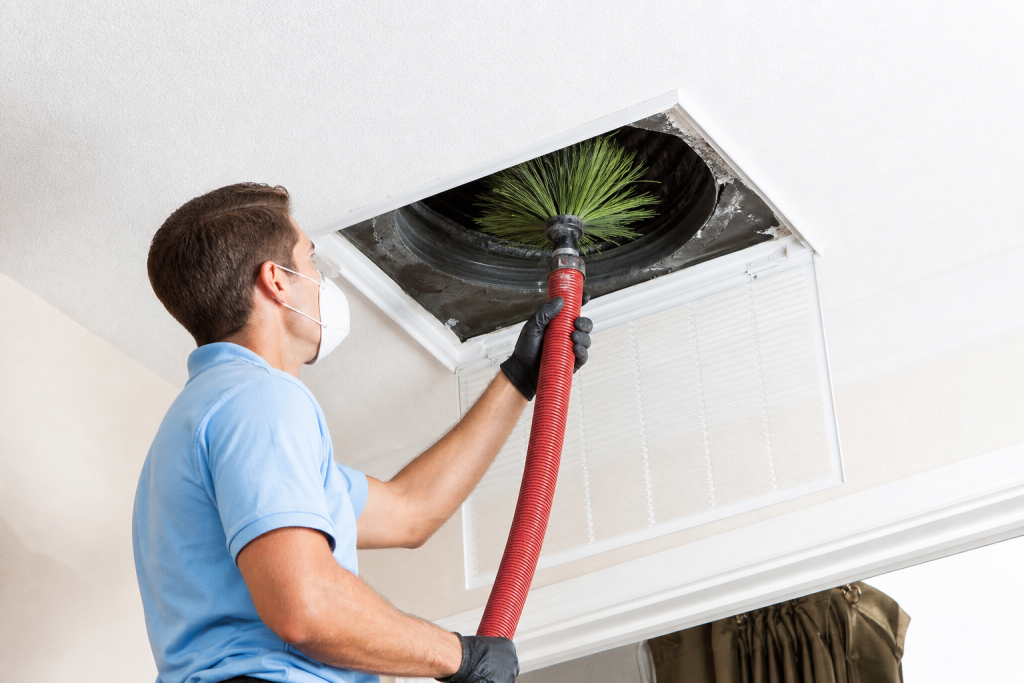
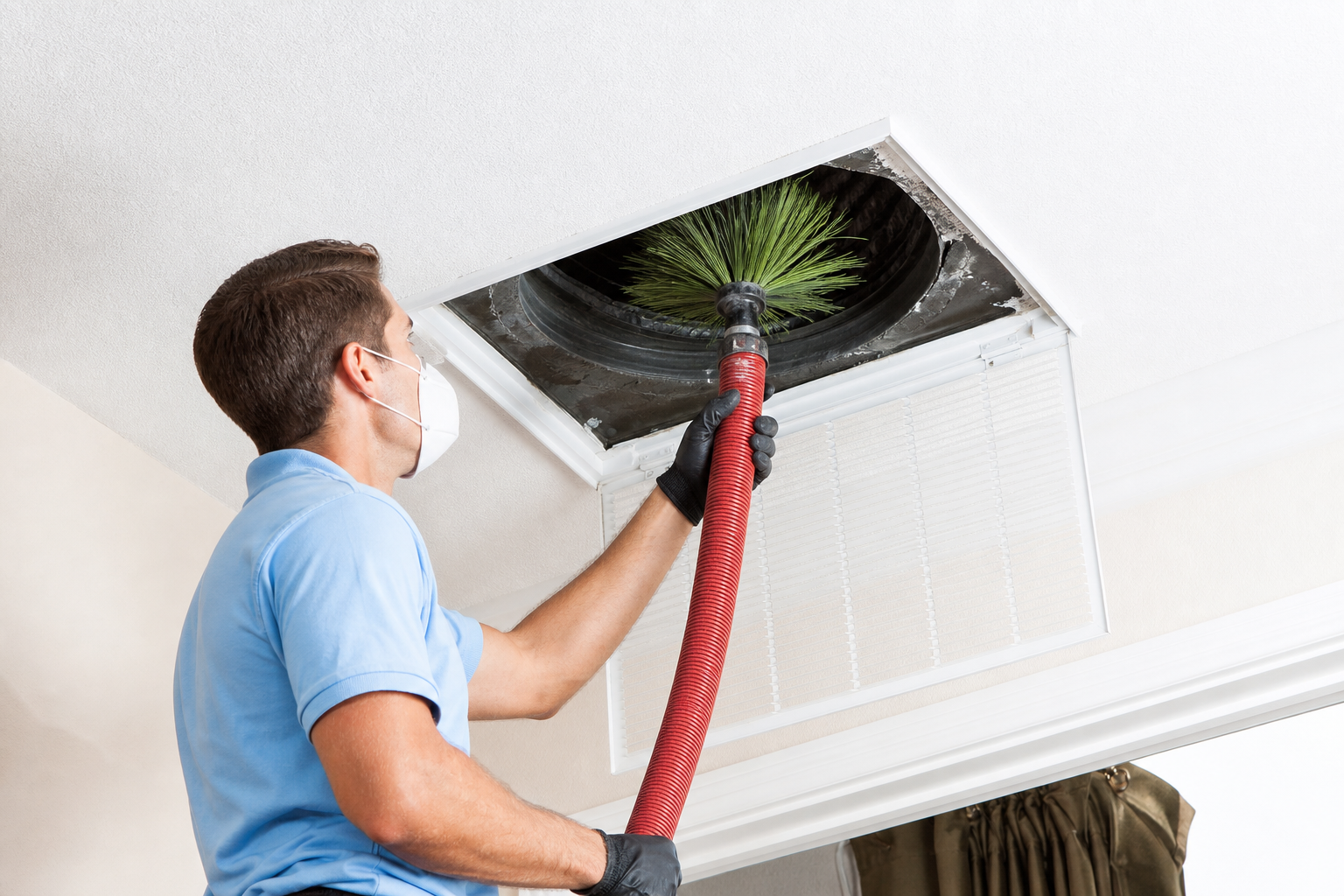
The oily nature of puff-back soot means it bonds to duct surfaces. Standard brushing can spread it. We use our Rotobrush system with HEPA containment from Abatement Technologies, but even that has limits if the soot has been circulated by a running blower.
Flood or Water Intrusion in Ductwork
Akron’s clay-heavy soils and aging storm infrastructure mean basement flooding isn’t rare — particularly in low-lying areas near the Little Cuyahoga or in homes with foundation seepage. When water enters your duct system, the clock starts on mold growth.
First 30 minutes:
- Shut the HVAC system off to prevent moisture distribution
- If water is actively entering, identify and stop the source if safely possible
- Remove standing water from around floor registers with a wet/dry vacuum
- Document water depth and affected registers with photos
Here’s what most homeowners miss: fiberglass duct liner — common in 1980s and 90s Akron construction — acts like a sponge. Surface drying doesn’t reach the interior. We’ve opened duct systems in Ellet and Kenmore where the exterior looked dry but the liner was saturated three inches deep. That requires replacement, not cleaning.
Visible Mold at Registers
Spotting mold around your vents doesn’t automatically mean your entire duct system is contaminated. In Akron’s humid summers, condensation at cold metal registers can grow surface mold while the main trunk stays clean.
First 30 minutes:
- Shut the system off to stop spore circulation
- Do not disturb the mold with household cleaners or scrubbing
- Photograph the affected areas with a ruler or coin for scale
- Note whether the growth is on the register face, inside the boot, or visible deeper in the duct
We use Nikro equipment with HEPA filtration to collect samples and assess whether the contamination is surface-level or systemic. Guardsman sanitizing treatments work for verified organic growth, but only after mechanical removal — spraying sanitizer on visible mold is like painting over a leak.
When to Shut Your HVAC Off Entirely: A Simple Decision Tree
Not every duct issue requires killing power to your whole system. Use this framework in the first half-hour:
- Any smoke, soot, or burning smell? Shut off completely. Running the system compounds damage exponentially.
- Water in or around ducts? Shut off completely. Moisture + airflow = mold amplification.
- Visible mold confined to one register, no musty smell from vents? Shut off as precaution, but isolated surface mold may not require full system treatment.
- Unexplained respiratory symptoms or persistent musty odor? Shut off and schedule assessment — this often indicates hidden contamination.
- Recent rodent activity or droppings near vents? Shut off — disturbed droppings aerosolize. This requires specialized remediation, not standard cleaning.
The exception: extreme cold. If shutting off your furnace risks frozen pipes in a January Akron cold snap, open windows near the problem area, seal that register with plastic and tape, and run the system on the lowest setting that maintains safe temperatures. Then call for same-day assessment.
What Emergency Duct Cleaning Can and Cannot Fix
We’re straightforward about limits. After 387 verified reviews and 11 years in Akron homes, our reputation depends on it.
Emergency cleaning works for:
- Recent puff-back soot where the blower was shut off promptly — our Rotobrush and HEPA systems can remove unsettled residue
- Light water intrusion caught within 24–48 hours, with metal ductwork (no fiberglass liner saturation)
- Surface mold on accessible components, verified as non-systemic
- Post-construction debris or pest entry points that haven’t established colonies
Cleaning cannot fix — remediation required:
- Saturated fiberglass duct liner (replacement only)
- Extensive mold in porous materials or behind vapor barriers
- Sewage contamination of any kind
- Structural duct damage from fire or water
- Asbestos-containing duct wrap (common pre-1980 Akron housing stock)
We pulled a system in a garage over in Highland Square last month where a homeowner had run their blower for three hours after a puff-back, trying to “clear the smell.” The soot had embedded in flex duct so thoroughly that replacement was the only option. A $600 cleaning became a $3,400 re-duct. First 30 minutes matter.
How to Vet an Emergency Duct Contractor in Akron
Not every company taking “emergency” calls has emergency capability. Here’s what to ask before they dispatch:
- “What equipment will you bring?” — Look for named systems: Rotobrush, Nikro, or equivalent HEPA-contained equipment. “Our truck-mounted vacuum” without specifics often means a Shop-Vac on steroids.
- “Will the owner or lead technician be on site?” — In our experience, emergency work requires judgment that comes from years of field diagnosis. Matthew handles emergency assessments personally for exactly this reason.
- “What’s your containment protocol?” — Any emergency cleaning should isolate the work area. Abatement Technologies negative-air machines or equivalent are the standard.
- “Can you document for insurance?” — See next section. If they hesitate, keep calling.
Red flags: quotes over the phone without inspection, pressure to book immediately, equipment that looks like it came from a rental center, or technicians who can’t explain the difference between cleaning and remediation.
Documentation That Saves Your Insurance Claim
Most Akron homeowners don’t think about insurance documentation until the adjuster asks — usually weeks later, when evidence is gone. Here’s what to collect:
During the event:
- Timestamped photos of the source (furnace, flood point, visible growth)
- Photos of affected registers with the system still off
- Weather data for the date (flooding claims often require this)
- Any contractor correspondence with timestamps
During cleaning:
- Before/after photos inside the ductwork (ask your contractor — we provide these automatically)
- Written scope of work with specific equipment and methods used
- Air quality readings if available (particle counts, spore trap results)
- Disposal receipts for contaminated materials
After completion:
- Final inspection report with photos
- Any recommended follow-up (sealing, sanitizing, monitoring)
- Warranty or guarantee documentation
Adjusters in Summit County see a lot of duct claims. The ones that process smoothly have clear documentation chains. The ones that stall are missing “before” photos or have vague contractor invoices that say “cleaned ducts” without specifying methods or extent.
Related Services in Akron
Emergencies often reveal underlying issues. If your assessment shows systemic contamination, damaged ductwork, or recurring moisture problems, Elite Air Duct Cleaning Service Greater Akron home provides full-scope solutions. We also serve neighboring communities with Air Duct Cleaning in Mayfield Heights, Dryer Vent Cleaning in Mayfield Heights, and HVAC Cleaning in Mayfield Heights.
What happens when you call
- 1
A real person answersNo phone trees — you reach a local pro.
- 2
You get an upfront price rangeHonest numbers before anyone is dispatched.
- 3
A background-checked tech heads outLicensed & insured, dispatched right away.
- 4
You approve before work beginsNothing starts until you say go.
The Bottom Line
Emergency duct situations in Akron reward the homeowner who acts deliberately in the first 30 minutes. Shut the system off when contamination is present. Don’t run the blower to “test” or “clear” anything. Document everything. And know that cleaning has real limits — sometimes remediation or replacement is the honest answer.
After 11 years and nearly 400 verified reviews, we’ve built our reputation on telling homeowners the truth about what their system needs, even when it’s not the answer they hoped for. If you’re facing a duct emergency in Akron and want an owner-technician assessment — not a dispatched crew with a sales quota — call (866) 970-8150. Matthew handles emergency calls personally, and estimates are always free.
Frequently Asked Questions
Emergency duct cleaning in Akron typically ranges from $400 for a localized puff-back in a small system to $1,200 for whole-house contamination requiring HEPA containment and multiple access points. Flood and mold scenarios may cost more if duct liner replacement is needed. We provide exact quotes after inspection — call (866) 970-8150 for a free estimate.
Yes — we maintain same-day availability for true emergencies: puff-backs, active water intrusion, and verified mold with HVAC shutdown. Response time depends on current job location, but we serve all Akron neighborhoods including Firestone Park, Ellet, Kenmore, and West Akron. Call (866) 970-8150 and we’ll give you a realistic arrival window.
With the HVAC system off, short-term occupancy is usually safe for puff-back and isolated mold scenarios. Flood situations with sewage or extensive water require evacuation until assessment. When in doubt, shut the system off and ventilate naturally — don’t use fans that pull air through the return system. We can advise by phone while en route.
Most policies cover sudden, accidental events like puff-backs and water damage from burst pipes. Maintenance-related mold or gradual deterioration typically isn’t covered. Documentation is critical — photos, timestamps, and detailed contractor invoices. We provide insurance-compliant documentation with every emergency cleaning. Call (866) 970-8150 and we’ll help you understand what’s needed for your claim.
Written by Matthew Gonzalez, Owner & Lead Technician at Elite Air Duct Cleaning Service Greater Akron, serving Akron since 2015.
Need Air Duct Cleaning Help?
Call Elite Air Duct Cleaning Service Greater Akron — licensed & insured, here with fast after-hours help in Akron.
(866) 970-8150