
Last updated July 10, 2026
Air Duct Cleaning Maintenance Checklist for Akron Homeowners
Here’s a sobering truth we’ve encountered in hundreds of Akron homes: homeowners who replace filters on schedule but never check the return-air plenum are essentially vacuuming the living room while leaving the hallway carpet untouched for a decade. The debris you see on your floor registers? That’s often just the overflow from a much larger accumulation hiding in the trunk lines, plenum boxes, and coil faces upstream. In our 11 years cleaning duct systems across Akron — from the older balloon-frame homes in Highland Square to the ranch-style builds in Firestone Park — we’ve learned that a duct-cleaning checklist isn’t a reminder to schedule a service call. It’s a 12-month homeowner audit framework that catches the upstream conditions (filter habits, register blockages, moisture intrusion) that determine whether your ducts stay clean for three years or get filthy in one. This guide gives you that framework, tuned specifically to Akron’s seasonal heating and cooling demands.
Quick Answer
A complete air duct maintenance checklist for Akron homeowners includes monthly filter checks, quarterly register and return-grille inspections, biannual coil and drain pan assessments during peak HVAC seasons, and a full professional duct cleaning every 3–5 years — or sooner after trigger events like renovation, water damage, or pet adoption. The checklist below breaks these tasks into a month-by-month calendar aligned with Akron’s heating-heavy winters and humid summers.
Table of Contents
- The Akron Seasonal Calendar: Month-by-Month Duct Tasks
- The Five Hidden Checkpoints Inside Your Duct System
- Surface Dust vs. Deep Contamination: How to Tell the Difference
- MERV Rating Reality: When a Better Filter Makes Things Worse
- Trigger Events That Override Your Normal Cleaning Interval
- The Dryer Vent Oversight: A Fire Risk Most Akron Homes Ignore
- Common Mistakes to Avoid
- When to Call a Professional
- Frequently Asked Questions
The Akron Seasonal Calendar: Month-by-Month Duct Tasks
Akron’s climate demands more from your HVAC system than most homeowners realize. With roughly 4,200 heating degree days annually and summers that push humidity above 70% for weeks at a stretch, your ducts work harder here than in drier, milder markets. Our maintenance calendar reflects that reality.
January–February (Peak Heating Load)
Your furnace is running 8–12 hours daily. This is when we see the most significant filter loading in Akron homes, especially those with forced-air systems common in North Hill and Ellet’s post-war housing stock.
- Check your filter every 30 days — fiberglass filters may need replacement; pleated filters should be inspected for bypass (debris slipping around a warped frame).
- Walk every room and confirm supply registers are fully open; closed registers in unused rooms create back-pressure that strains flex-duct connections in crawl spaces.
- Listen for whistling at return grilles — this indicates high suction that can pull attic or crawl space debris into the system through gaps in the return plenum.
March–April (Shoulder Season / Thaw)
Akron’s spring thaw brings moisture intrusion risks, particularly in homes with basements or crawl spaces in neighborhoods like Goodyear Heights where the water table sits high.
- Inspect the return-air plenum for rust streaks or water staining — signs that spring humidity is condensing on cold duct surfaces.
- Run your hand along exposed ductwork in the basement; any grittiness indicates dust accumulation that will mobilize when the AC starts.
- Schedule your professional duct cleaning if it’s been 3+ years, before the summer cooling load begins.
May–June (Pre-Cooling Preparation)
Before the first 85-degree day hits Akron, verify your system can handle the transition from heating to cooling without blowing accumulated debris through clean coils.
- Replace the filter regardless of apparent condition — heating-season debris differs from summer pollen and dander.
- Visually inspect the evaporator coil face through the access panel (or have it done during your HVAC tune-up); a dirty coil reduces airflow and can harbor mold in Akron’s humidity.
- Confirm your condensate drain pan isn’t holding standing water — a full pan breeds microbial growth that enters the airstream.
July–August (Peak Cooling / Humidity)
This is when we field the most odor complaints in Akron — musty smells, “dirty sock syndrome,” and visible mold around registers in homes with poor drainage or oversized AC units that short-cycle.
- Run your system continuously on “Fan” mode for 30 minutes daily to promote air circulation and prevent stagnant zones in duct branches.
- Check ceiling registers in second-floor rooms — these are the first to show condensation staining if attic duct insulation has degraded.
- Monitor your energy bill; a 15%+ spike without weather change often indicates restricted airflow from duct contamination.
September–October (Shoulder Season / Leaf Debris)
Akron’s fall leaf drop affects outdoor HVAC components, but indoor ductwork needs attention too before heating season returns.
- Vacuum return grilles with a brush attachment — summer’s accumulated skin cells, pollen, and pet hair cluster here.
- Inspect the furnace filter slot for gaps; many Akron homes have retrofitted filters that don’t seat properly in older filter racks.
- Schedule dryer vent cleaning before the heavy sweater and bedding season — lint accumulation accelerates in fall.
November–December (Heating Season Launch)
- Install a fresh filter and mark the date — you’ll need a baseline for January’s inspection.
- Test every thermostat zone; uneven heating often traces to duct leakage or blockage, not furnace malfunction.
- Walk the perimeter of your home and confirm no vents are blocked by stored holiday items — a surprisingly common fire and airflow hazard in Akron’s smaller ranch homes.
The Five Hidden Checkpoints Inside Your Duct System
Most homeowners never look past the register. In 11 years of cleaning duct systems across Akron, Matthew has identified five critical inspection points that reveal whether your ducts are merely dusty or genuinely compromised. These require a flashlight, a mirror on an extension pole (available at any hardware store), and in some cases, removing a register or access panel.
1. Supply Boots (Where Duct Meets Register)
The boot is the sheet-metal transition between your duct branch and the floor or wall register. In Akron’s older homes — particularly the 1920s-era construction in West Akron and Merriman Valley — these boots often sit in exterior walls with minimal insulation. We regularly find mold staining, construction debris from original build-out, and in some cases, rodent droppings accumulated over decades. Shine your flashlight down the boot; if you see debris more than 1/4 inch deep, or any dark staining on the metal, that’s beyond DIY maintenance.
2. Return-Air Plenum (The System’s “Hallway”)
The return plenum is the large central duct that collects air from all your return grilles and delivers it to the furnace. It’s the most overlooked component in residential duct maintenance. In our experience, 60% of Akron homes have significant debris accumulation here — not because homeowners neglect filters, but because standard 1-inch filters don’t seal perfectly, and bypass debris settles in the plenum. Remove the filter and photograph the plenum floor; if you see a gray, fuzzy layer, that’s your system’s true contamination level.
3. Evaporator Coil Face (Cooling Season Critical)
Located above your furnace, the coil face is where airborne debris impacts first when your AC runs. A dirty coil acts like a filter that never gets changed — airflow drops, efficiency plummets, and the coil becomes a microbial growth medium in Akron’s humid summers. Most homeowners can’t access this without removing panels; if you’re comfortable doing so, look for gray fuzz or uniform gray film across the aluminum fins. Uniform gray film is normal dust; clumpy or dark accumulation indicates deeper system issues.
4. Condensate Drain Pan (Moisture Control)
This pan sits beneath the evaporator coil and catches condensation. In Akron’s climate, it should drain freely to a floor drain or pump. Stagnant water here is the single biggest predictor of musty duct odors we encounter. Check during AC operation — water should flow, not pool. If you see sediment, slime, or algae, the pan needs professional cleaning and the drain line needs clearing.
5. Flex-Duct Connections (The Weak Links)
Flex duct — the ribbed, insulated tubing common in Akron homes built after 1980 — connects to metal trunk lines with zip ties or clamps. These connections loosen over time, especially in crawl spaces where temperature swings cause expansion and contraction. In neighborhoods like Kenmore and Barberton-adjacent areas with high water tables, we’ve found collapsed flex duct, disconnected runs blowing into crawl spaces, and connections so loose they pull in fiberglass insulation particles. Feel for airflow at connections during system operation; any leakage here wastes energy and contaminates air.
Surface Dust vs. Deep Contamination: How to Tell the Difference
Not every dusty register demands professional intervention. Here’s how Akron homeowners can self-assess what they’re seeing.
Surface Accumulation (Manageable DIY)
- Dust wipes off with a damp cloth and doesn’t return within 2–3 weeks
- Visible only on the register face and first 2–3 inches of visible duct
- No odor when the system runs
- Consistent across all rooms — not isolated to one branch
- Filter has been changed within 60 days and seats properly
Deep Contamination (Requires Professional Extraction)
- Dust returns within days of cleaning registers
- Visible debris extends beyond the boot into the branch duct (use a mirror to check)
- Musty, oily, or “heated dust” odor when system cycles on
- Significantly worse in specific rooms — indicates branch blockage or leakage pulling from attic/crawl space
- Recent renovation, water damage, or pest activity
- Filter loads abnormally fast (replacement needed in under 60 days)
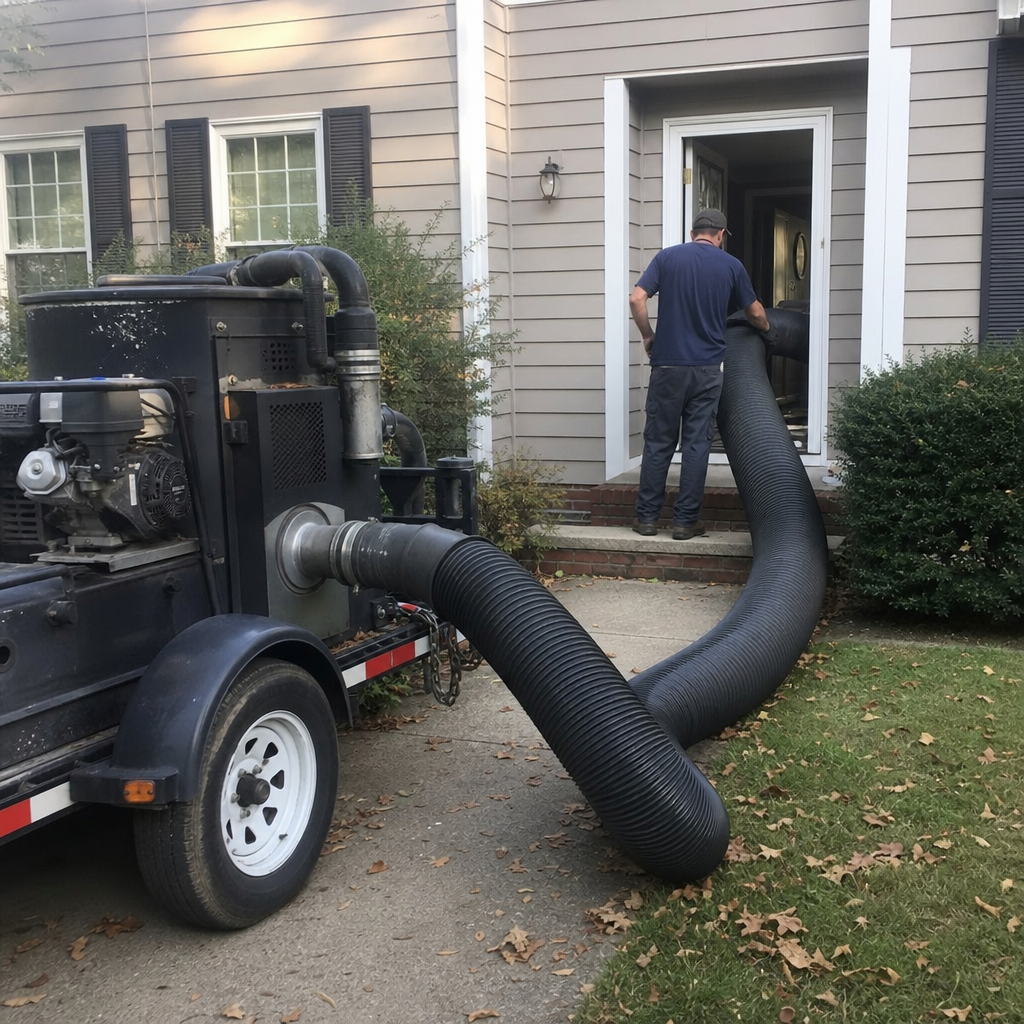
In our Akron work, we use professional-grade Rotobrush and Nikro systems to extract deep contamination — equipment that agitates debris from duct walls while maintaining negative air pressure so nothing escapes into your living space. Hardware-store vacuums and rental machines lack the suction and containment to handle deep accumulation safely.
MERV Rating Reality: When a Better Filter Makes Things Worse
This is where well-intentioned advice backfires. MERV ratings measure filter efficiency — higher numbers catch smaller particles. But in Akron’s older housing stock, a MERV-13 pleated filter can actually accelerate duct contamination.
Here’s why: older duct systems, common in West Akron, North Hill, and the bungalow neighborhoods near the University of Akron, were designed for airflow at 0.5 inches of water column static pressure or less. A MERV-13 filter adds significant resistance. Your blower motor works harder, airflow drops, and the system operates in a stressed state. Worse, the increased pressure differential can deform a 1-inch filter frame, creating bypass gaps where unfiltered air streams around the filter and deposits debris directly in the plenum.
We’ve opened systems in Akron homes where the MERV-13 looked pristine — because 40% of the air was bypassing it entirely.
Our Recommendation by Home Age:
- Pre-1970 homes with original ductwork: MERV-6 to MERV-8 pleated, changed every 30–45 days. Consider a 4-inch media filter cabinet (Aprilaire and Honeywell make reliable units) if you want better filtration without the pressure penalty.
- 1970–1990 homes with partial updates: MERV-8 to MERV-11, monitored for filter deformation. Check the return plenum annually for bypass debris.
- Post-1990 homes with modern blowers: MERV-11 to MERV-13 acceptable, but verify your HVAC contractor sized the blower for the filter type.
The goal is matching filter efficiency to system capability — not buying the highest number on the shelf. In our experience, a properly seated MERV-8 changed on schedule protects duct cleanliness better than a warped MERV-13 changed twice yearly.
Trigger Events That Override Your Normal Cleaning Interval
The standard 3–5 year professional cleaning interval assumes stable conditions. Several events should reset your clock to zero, regardless of when you last cleaned.
Home Renovation
Any project involving drywall sanding, flooring removal, or wall demolition generates fine particulate that your HVAC system will ingest. In Akron’s active renovation market — particularly the historic home restorations in Highland Square and Wallhaven — we’ve extracted pounds of construction dust from ducts within months of project completion. The dust is finer than household debris, penetrates deeper into the system, and often contains irritants from modern building materials. Schedule duct cleaning after final cleanup, before occupancy.
Water Damage or Flooding
Akron’s spring storms and basement vulnerability make this relevant. Any water intrusion that reaches ductwork — even flex duct in a damp crawl space — creates conditions for mold growth. Musty odors appearing 2–6 weeks after a water event are a clear signal. Don’t attempt DIY remediation; mold in porous duct insulation requires professional handling with proper containment.
New Pet Adoption
Pet dander is smaller and more adhesive than human skin cells. It clings to duct walls and provides a protein food source for dust mites. We’ve seen systems go from clean to significantly contaminated within 18 months of pet adoption, particularly in homes with multiple animals or breeds with dense undercoats.
HVAC System Replacement
New equipment often connects to old ductwork. The installation process disturbs decades of accumulated debris, and the new blower’s different airflow characteristics can mobilize settled contamination. We recommend duct cleaning concurrent with or immediately following any furnace or AC replacement.
Occupancy Change in Rental Properties
For Akron’s significant rental market — particularly the student-adjacent areas near the University of Akron — duct cleaning between tenants protects both property condition and liability. Previous occupants’ smoking, pets, or neglect become your next tenant’s air quality problem.
The Dryer Vent Oversight: A Fire Risk Most Akron Homes Ignore
While this guide focuses on HVAC ductwork, we’d be remiss not to address the duct system that causes more residential fires than all others combined: your dryer vent. In our dryer vent cleaning work, we’ve extracted lint accumulations that reduce airflow by 70% or more — creating overheating conditions that can ignite the highly flammable material.
Akron’s older housing compounds this risk. Many homes in Firestone Park, Kenmore, and Goodyear Heights have original dryer vent routing through 4-inch flexible transition duct, then into wall cavities with multiple elbows, terminating through soffits or roof jacks that are difficult to inspect. Lint accumulates at every elbow and in low-velocity sections near the termination.
Monthly Homeowner Check: Run your dryer on air-only for 5 minutes, then check exterior airflow. It should feel forceful and warm. Weak flow, extended dry times (over 45 minutes for a standard load), or a dryer cabinet that feels unusually hot are all warning signs. The Elite Air Duct Cleaning Service Greater Akron home page details our full dryer vent service, which includes airflow testing and complete lint extraction.
For property managers in Akron’s multi-family market, we recommend annual dryer vent inspection as part of fire safety compliance — it’s addressed less often than it should be, and the consequences of neglect are severe.
Common Mistakes to Avoid
- Closing registers in unused rooms. This seems logical but increases static pressure, strains duct connections, and can cause your blower motor to overamp. In Akron’s older homes with already-marginal duct design, it’s a recipe for system failure. Use balance dampers in the basement if available, or accept slightly higher conditioning costs.
- Installing a “permanent” or “washable” filter without understanding the tradeoffs. These electrostatic filters load quickly and are rarely cleaned thoroughly by homeowners. We’ve opened systems where the filter was so clogged it had bowed into the blower compartment, bypassing all filtration for months.
- Ignoring the return side entirely. Supply registers get attention because they’re visible. Return grilles — often larger, sometimes floor-mounted in traffic paths — collect far more debris and are the primary entry point for unfiltered air if gaps exist. Vacuum them monthly.
- Using scented filters or vent “fresheners.” These mask odors rather than address causes. In our Akron experience, the underlying problem is usually microbial growth in the coil or drain pan, or dead organic matter in the ductwork. Covering the smell with fragrance doesn’t fix the contamination and can introduce volatile compounds.
- Assuming new construction means clean ducts. Some of the most contaminated systems we’ve cleaned were in homes less than 5 years old. Construction debris — drywall dust, wood particles, fast-food wrappers left by workers — sits in new ductwork until the homeowner moves in and activates the system. If you bought new construction in Akron’s expanding townhome developments, consider a post-construction cleaning before occupancy.
- Waiting for visible dust at registers before acting. By the time debris reaches your supply registers, the upstream system is heavily loaded. The register is the end of the line, not the beginning. Proactive inspection of the plenum and coil prevents the visible problem entirely.
- Attempting DIY duct cleaning with inadequate equipment. We’ve repaired damage from homeowners who used shop vacuums with brush attachments, dislodging debris without proper containment and coating their homes in fine particulate. Professional extraction requires negative air machines and HEPA containment — the Abatement Technologies equipment we deploy for this purpose.
When to Call a Professional
Certain conditions exceed homeowner capability and require specialist intervention. Call for professional assessment if you observe: persistent musty odors regardless of filter changes; visible mold anywhere in the system; water staining or rust on ductwork; airflow reduction of 20% or more at registers; recent water damage, renovation, or pest activity; or if it’s been 4+ years since your last professional cleaning.
Matthew handles this job personally — not a dispatched crew — and brings 11 years of diagnostic experience to every Akron home we serve. Elite Air Duct Cleaning Service Greater Akron offers free estimates in Akron; call (866) 970-8150 to schedule. Our Air Duct Cleaning in Mayfield Heights and surrounding area pages detail our full service scope, including HVAC Cleaning in Mayfield Heights for integrated system care.
Frequently Asked Questions
Most complete residential duct cleanings in the Akron market range from $400 to $800 for a single-system home, depending on duct complexity, accessibility, and contamination level. Homes with multiple HVAC zones, extensive flex duct in crawl spaces, or severe contamination requiring sanitizing treatment fall at the higher end. Call (866) 970-8150 for an exact quote — estimates are free, and Matthew assesses each home personally rather than quoting blind over the phone.
For typical Akron homes without pets, non-smoking occupants, and no recent renovation, every 3 to 5 years is appropriate. Homes with multiple pets, allergy-sensitive occupants, or located near Akron’s industrial corridors (Goodyear, Firestone legacy areas with higher ambient particulate) benefit from 2 to 3 year intervals. Any trigger event — renovation, water damage, new pet, HVAC replacement — should prompt immediate assessment regardless of elapsed time.
Homeowner maintenance — filter changes, register vacuuming, return grille cleaning — is essential and effective for surface management. However, deep extraction from trunk lines, plenums, and branch ducts requires professional-grade negative air machines, rotary brush systems, and HEPA containment that aren’t available for consumer rental. Attempting deep cleaning with inadequate equipment risks damaging ductwork and dispersing contamination throughout your home. For genuine system restoration, professional service is necessary.
Rapid re-dusting usually indicates one of three conditions: your filter isn’t sealing properly and bypass debris is circulating continuously; your return ductwork has leakage that’s pulling attic or crawl space debris into the system; or your ducts are so heavily loaded that normal airflow mobilizes settled contamination. In Akron’s older housing stock, we find return leakage particularly common — the negative pressure in return ducts pulls from the path of least resistance, which is often gaps in basement or crawl space connections.
Cleaning removes particulate debris; sanitizing addresses microbial contamination. We recommend sanitizing when: mold or mildew is present; there has been water damage; occupants have significant allergy or respiratory sensitivity; or pet dander accumulation is severe. We use Guardsman-brand products for documented, brand-backed results — not generic treatments. For routine maintenance cleaning without these conditions, extraction alone is typically sufficient.
Air duct cleaning addresses the distribution network — trunk lines, branch ducts, boots, and registers. HVAC cleaning includes the mechanical components: blower assembly, evaporator coil, heat exchanger, and condensate system. In our integrated approach, we assess both because they’re interdependent. A clean duct system connected to a contaminated coil will re-contaminate quickly; conversely, a clean coil with debris-filled ducts restricts airflow and strains the equipment. For complete system health, both need attention.
The Bottom Line
Effective duct maintenance in Akron isn’t about obsessive filter replacement — it’s about understanding your system as an integrated whole and inspecting the components that actually determine air quality. The five hidden checkpoints, the seasonal calendar tuned to our local climate, and the trigger events that demand immediate attention give you a framework that prevents problems rather than reacting to symptoms. Use this checklist monthly, act on what you find, and schedule professional cleaning when conditions warrant. Your ducts will stay cleaner longer, your HVAC system will run more efficiently, and the air your family breathes will reflect the effort you’ve invested.
Written by Matthew Gonzalez, Owner & Lead Technician at Elite Air Duct Cleaning Service Greater Akron, serving Akron since 2015.