
Last updated July 10, 2026
The Complete Guide to Air Duct Cleaning in Akron
After crawling inside thousands of duct systems across Summit and Cuyahoga counties, the single most common finding isn’t dust — it’s compacted debris the previous “cleaning” never touched because the tech never left the basement. In Akron’s 1950s-to-1980s ranch and split-level neighborhoods, from Firestone Park to Ellet, we’ve pulled out insulation fragments, construction debris from original builds, and pollen-compacted mats that generic vacuum passes simply redistribute. This guide draws on 11 years of hands-on diagnostic work to show you exactly what proper air duct cleaning in Akron involves, when your home actually needs it, and how to tell a genuine specialist from someone with a shop vac and a coupon.
Quick Answer
Professional air duct cleaning in Akron typically costs $300–$700 for a standard residential system and should take 3–5 hours with rotary-brush agitation and negative-air extraction. For most Akron homes built between 1950 and 1985, we recommend cleaning every 3–5 years, though homes with pets, allergy sufferers, or finished basements with moisture issues may need service every 2–3 years. The key differentiator is whether the technician physically accesses and agitates debris at each branch line — not just vacuums the main trunk from the basement.
Table of Contents
- Why Akron’s Older Housing Stock Changes Everything
- Truck-Mounted vs. Rotary-Brush: The Mechanical Difference
- How to Read the Signs Your Ducts Actually Need Cleaning
- Northeast Ohio’s Climate Acceleration Factors
- What a Proper Cleaning Looks Like Step by Step
- Post-Cleaning Inspection: What Documentation to Demand
- Cleaning vs. Replacement vs. Sealing: Making the Right Call
- How to Choose a Duct Cleaning Provider in Akron
Why Akron’s Older Housing Stock Changes Everything
Akron’s residential core was built during a concentrated window — roughly 1950 through 1985 — when fiberglass duct board, unlined metal trunk lines, and early flex-duct transitions were standard. These materials behave differently than modern ductwork, and they accumulate contamination in patterns that national franchise playbooks rarely address.
In Firestone Park and Goodyear Heights, we regularly find original metal trunks with no internal lining. Over decades, the zinc galvanization degrades, creating microscopic pitting where fine debris locks in place. A standard negative-air vacuum — the kind that hooks to your basement trunk and pulls for two hours — generates airflow at 4,000–6,000 CFM but produces minimal surface agitation. The debris stays put. We’ve opened systems in Kenmore that had three prior “cleanings” from national brands, yet our rotary brush still pulled out compacted layers of pollen, skin cells, and degraded insulation.
Split-levels in Merriman Valley and Wallhaven present another Akron-specific challenge: multiple duct zones with long horizontal runs through slab-adjacent crawl spaces. These low-velocity sections collect debris that vertical risers never see. In winter, when the furnace runs continuously, thermal cycling drives humidity through these cool zones, binding dust into clay-like masses. Spring pollen season in Northeast Ohio — typically late April through mid-June — adds a fresh annual layer that compounds the problem.
The construction era also matters for what’s inside the debris. Pre-1980 homes in Akron often contain original cellulose insulation fragments, construction sawdust from built-in-place cabinetry, and occasionally degraded duct tape adhesive that becomes a sticky matrix trapping particles. Generic cleaning doesn’t address these bonded contaminants. Targeted agitation — the kind our Rotobrush system delivers with its spinning bristle head — breaks the bond so negative-air extraction can actually remove it.
Key Akron neighborhoods with distinct duct profiles:
- Firestone Park / Goodyear Heights: Original unlined metal, often with galvanized degradation and construction-era debris
- Merriman Valley / Wallhaven: Split-level multi-zone systems with long horizontal low-velocity runs
- Ellet / Springfield: Ranch homes with slab-on-grade returns prone to moisture-driven microbial growth
- Highland Square / West Akron: Older conversions with mixed duct materials from decades of partial renovations
Truck-Mounted vs. Rotary-Brush: The Mechanical Difference
Most Akron homeowners don’t realize that “duct cleaning” describes two fundamentally different mechanical processes. Understanding the distinction protects you from paying for the wrong approach — or paying for an approach that can’t succeed on your duct type.
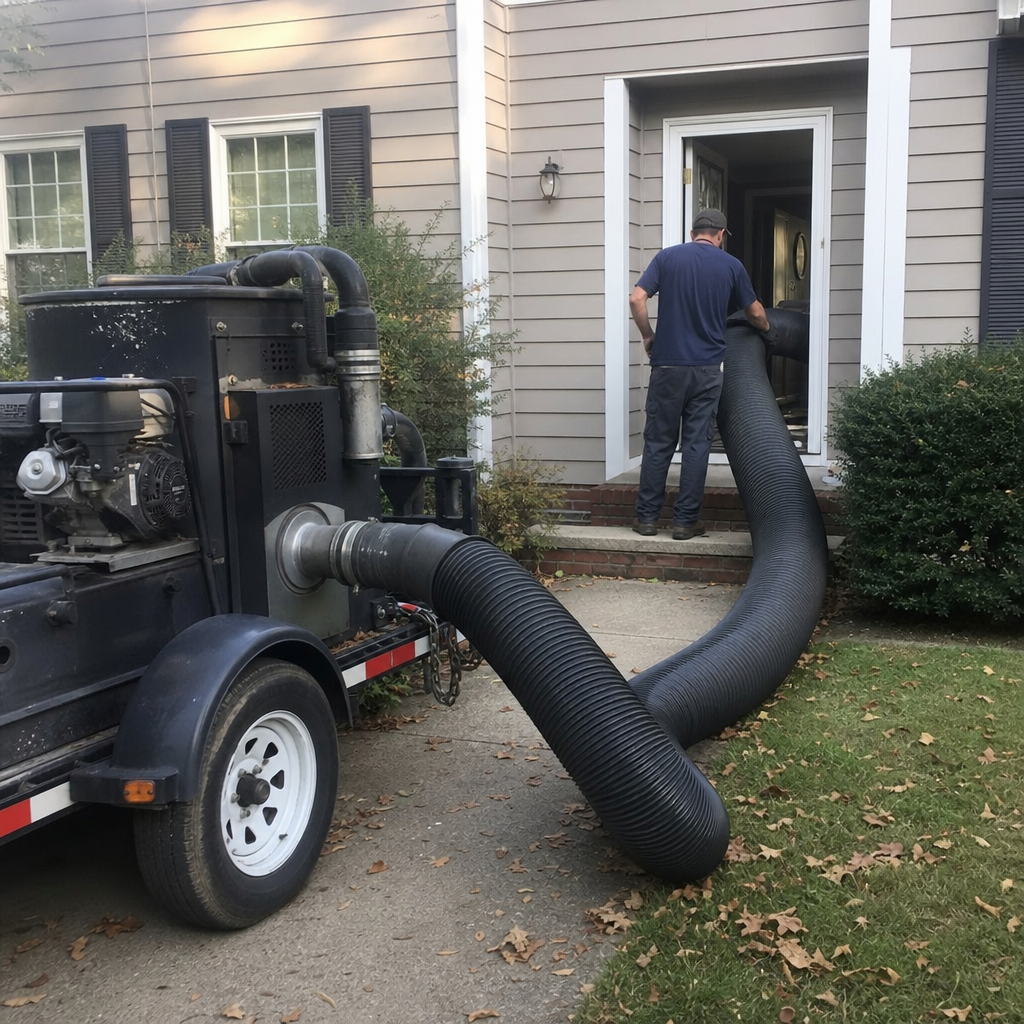
Truck-mounted negative-air systems use a large gasoline-powered vacuum (typically 10,000+ CFM) mounted in a service vehicle. A 10-inch hose connects to your main trunk line in the basement or utility room. The system pulls continuous negative pressure through the entire duct network. This is powerful for loose, dry debris in large-diameter commercial metal ductwork. It’s less effective on residential systems with smaller branch lines, internal corners, and — critically — debris that’s compacted or adhered to duct walls.
Rotary-brush systems like our Rotobrush and Nikro equipment send a flexible cable with a rotating bristle head through each branch line individually. The bristles physically contact and agitate the duct interior, breaking bonded debris free. A concurrent vacuum (either portable HEPA or truck-mounted) captures the dislodged material at the point of generation. This is slower — each branch line must be accessed and cleaned separately — but it’s the only method that removes compacted contamination from residential ductwork.
Here’s how we decide which approach to deploy in Akron homes:
| Duct Type | Best Method | Why |
|---|---|---|
| Unlined metal trunks (pre-1970) | Rotary-brush + portable HEPA | Galvanized pitting traps debris; requires physical agitation |
| Fiberglass duct board (1970s–1990s) | Controlled rotary-brush, low RPM | Board surface can fray; needs gentle but direct contact |
| Flex-duct branches (all eras) | Rotary-brush with soft poly bristles | Internal ribs create debris pockets; negative-air alone misses these |
| Sheet metal with internal liner | Negative-air with strategic agitation | Liner can delaminate if over-agitated |
In our experience across Akron, approximately 85% of residential systems benefit primarily from rotary-brush methods. The remaining 15% — typically newer homes in Fairlawn or Bath with well-maintained lined metal — can achieve adequate results with negative-air alone, though we still verify with camera inspection. National franchises pushing truck-mounted-only approaches are optimizing for speed and crew throughput, not your specific duct profile.
The equipment brand matters for accountability. Our Rotobrush and Nikro systems are purpose-built for residential duct geometry, with brush heads sized from 4 to 18 inches and torque-controlled motors that prevent duct damage. Hardware-store vacuums with 30-foot attachments — increasingly common from low-price competitors — lack the agitation force and sealed containment to do meaningful work.
How to Read the Signs Your Ducts Actually Need Cleaning
Not every dusty register indicates dirty ducts. After 11 years diagnosing Akron systems, we’ve developed a clear hierarchy of signals that distinguish genuine duct contamination from surface-level household dust or unrelated HVAC problems.
Visual indicators that warrant investigation:
- Persistent debris at supply registers after cleaning. If you’re wiping black or gray streaks from vent covers monthly, the source is upstream in the duct system, not your living space.
- Uneven dust distribution. One bedroom collects dust dramatically faster than an identical room? Often indicates a partial blockage or leak in that branch line creating turbulent deposition.
- Visible mold or microbial growth on register boots. In Akron’s humid summers, condensation at metal register connections can support growth — but the root cause is usually excessive moisture in the duct from poor insulation or basement humidity infiltration.
- Construction debris in new-to-you homes. Buying in Highland Square or West Akron where previous owners renovated? Sawdust, drywall compound, and insulation fragments commonly enter ducts during unprotected remodeling.
Performance indicators that suggest duct problems (cleaning may or may not be the full solution):
- Hot/cold spots with no register obstruction. If a room won’t maintain temperature despite open vents, you may have disconnected flex duct, collapsed liner, or significant blockage — not just dirty ducts.
- Increased energy bills with unchanged usage. Restricted airflow forces the blower motor to work harder. We’ve measured 15–25% efficiency recovery after cleaning heavily blocked systems in Ellet ranches.
- Furnace filter loading faster than 60 days. Standard 1-inch pleated filters should last 90 days in typical Akron homes. Faster loading means the duct system is recirculating accumulated debris.
When cleaning is NOT the right first step:
If your ducts are leaking — we commonly find 20–30% leakage in pre-1990 Akron homes — cleaning before sealing wastes money. The debris will re-enter through unsealed joints and disconnected boots. Similarly, ducts with degraded fiberglass liner or significant rust-through need repair or replacement, not cleaning. Matthew handles the diagnostic assessment personally to distinguish these scenarios before recommending any service.
Northeast Ohio’s Climate Acceleration Factors
Akron’s location in the Great Lakes snowbelt creates contamination patterns that faster-drying climates simply don’t produce. Understanding these regional factors helps set realistic maintenance intervals and explains why “every 7–10 years” advice from national sources fails here.
Humidity cycling: Akron averages 70%+ relative humidity from June through September, then drops to heated-air dryness below 30% in January. This annual swing drives moisture into duct materials, evaporates it, and leaves behind concentrated mineral and organic deposits. In basement utility rooms — common in Firestone Park and Goodyear Heights ranch homes — summer humidity infiltrates return plenums directly. We’ve measured duct interiors at 85% RH in July that drop to 25% by February. Each cycle deposits a new layer of bound particulate.
Pollen loads: Northeast Ohio’s tree pollen season (April–May) and ragweed season (August–September) are among the heaviest in the nation. Akron’s valley topography traps pollen in thermal layers that persist longer than in flat terrain. Once drawn into the HVAC system, pollen fragments — especially the sub-10-micron particles that penetrate filters — adhere to duct walls with humidity-activated stickiness. Homes with whole-house humidifiers, common in our market, accelerate this binding.
Basement moisture and slab returns: Many Akron ranches built on concrete slabs draw return air through perimeter channels cast into the slab. These “slab returns” are notoriously prone to moisture intrusion, especially in neighborhoods like Ellet and Springfield with higher water tables. When damp, they support microbial growth that conventional cleaning can’t fully address without concurrent moisture mitigation. Our assessments include slab-return inspection because cleaning alone would be temporary.
Heating-dominant operation: Akron’s heating season runs October through April — six months of continuous blower operation. Unlike cooling-dominant climates where systems cycle, our furnaces run extended periods that continuously recirculate and compact debris. The blower itself generates electrostatic charges that attract particles to duct walls. More runtime equals faster contamination buildup, plain and simple.
For most Akron homes, we recommend:
- Standard residential: every 3–5 years
- Homes with pets, allergy sufferers, or smokers: every 2–3 years
- Homes with slab returns or basement moisture issues: annual inspection, cleaning as indicated
- Post-renovation: immediate assessment, cleaning if construction debris entered system
What a Proper Cleaning Looks Like Step by Step
When Matthew handles this job personally — which is standard for every Elite Air Duct Cleaning appointment — here’s exactly what happens inside your Akron home. Use this as your benchmark for evaluating any provider.
Step 1: Pre-service assessment and access mapping (30–45 minutes)
We inspect every register, return, and accessible duct section before equipment enters your home. In Akron’s older homes, this often reveals surprises: abandoned register openings covered by flooring, flex duct that’s detached from boots, or previous repairs with incompatible materials. We photograph baseline conditions and note any repairs needed before cleaning proceeds.
Step 2: Protective containment setup
Using Abatement Technologies portable containment, we isolate the work zone from living spaces. Floor protection goes down at every entry point. This isn’t cosmetic — it’s how we prevent cross-contamination during debris removal.
Step 3: Register and boot removal
Every supply and return cover comes off for individual cleaning. The boot cavity behind each register — where debris commonly accumulates in a visible “collar” — is hand-cleaned and inspected. We’ve found dead birds, construction debris, and in one Kenmore home, a 1970s newspaper wadded as a crude damper.
Step 4: Rotary-brush agitation of branch lines
Our Rotobrush system sends the appropriate brush head through each branch line from register to trunk. Brush size matches duct diameter. Rotation speed adjusts for material — slower for fiberglass board, full torque for unlined metal. The concurrent vacuum captures debris at the register opening. Each branch typically takes 10–20 minutes.
Step 5: Main trunk line cleaning
The larger trunk connecting all branches receives rotary-brush treatment with an extended cable assembly, or negative-air extraction with strategic access cuts if geometry requires. In Akron homes with original basement trunks, this is where we most often find the compacted debris previous cleanings missed.
Step 6: Return system cleaning
Returns often contain more debris than supplies — they’re the intake path, pulling air (and particles) from your living space. We clean return grilles, return boots, and return ductwork with the same rotary-brush attention. Slab returns receive specialized treatment with sealed extraction to prevent basement contamination.
Step 7: Component cleaning (blower, coil, plenum)
The HVAC components downstream of your ducts — blower assembly, evaporator coil, and supply plenum — are inspected and cleaned as needed. Dirty ducts recontaminate clean components; dirty components recontaminate clean ducts. Addressing both is essential for lasting results.
Step 8: Sanitizing treatment (when indicated)
Where microbial growth or persistent odor is present, we apply Guardsman-brand sanitizing products with documented efficacy. This is not a substitute for physical cleaning — it’s a targeted treatment applied after debris removal, with dwell time and ventilation per manufacturer specification.
Step 9: Post-cleaning verification and documentation
See the next section for what this must include.
Post-Cleaning Inspection: What Documentation to Demand
The most common scam in our industry is the “trust me, it’s clean” departure. After 11 years, we’ve been called to re-clean dozens of systems where the previous provider left no evidence of work performed. Here’s what legitimate documentation looks like — and what Akron homeowners should refuse to accept without.
Mandatory documentation:
- Before/after photography of branch line interiors. Modern rotary-brush systems include integrated camera capability. We provide timestamped images from multiple branch lines showing debris condition pre- and post-cleaning. No camera? No proof.
- Debris quantity estimate. While exact weighing is impractical, we estimate volume removed (typically 2–8 pounds in standard Akron residential systems, occasionally 15+ pounds in neglected systems). This contextualizes the service value.
- System airflow measurement. Using a calibrated anemometer, we measure supply airflow at representative registers before and after cleaning. Improvement of 15–30% is typical for significantly blocked systems. Static pressure readings across the blower confirm system health.
- Written condition report. Any leaks, disconnected sections, deteriorated liner, or other issues discovered during cleaning are documented with location and recommended action. This transforms cleaning from a blind service into a diagnostic opportunity.
Red flags — documentation that proves inadequate service:
- Only exterior register photos (shows nothing about duct interiors)
- No timestamp or location metadata on images
- Verbal claims without written report
- Refusal to show debris collected (we bag and display significant findings)
In our experience, the providers who resist documentation are the same ones who never left the basement. Matthew’s owner-technician model means accountability: he’s the person who performed the work, explained the findings, and signed the report.
Cleaning vs. Replacement vs. Sealing: Making the Right Call
Not every dirty duct system should be cleaned. After diagnosing thousands of Akron systems, we’ve developed clear decision criteria that protect homeowners from wasting money on the wrong solution.
Clean when: Ducts are structurally sound with intact materials, moderate to heavy debris accumulation, no significant leakage, and no active moisture problems. This describes perhaps 60% of Akron homes we assess. The 11-year-old ranch in Ellet with original metal trunks and visible debris at registers? Clean it, seal minor leaks, and establish a maintenance interval.
Seal and repair when: Ducts are dirty AND leaking significantly. In pre-1990 Akron homes, we commonly measure 25–35% leakage to unconditioned spaces — basements, crawl spaces, wall cavities. Cleaning leaks debris into these spaces; sealing prevents recontamination. Our duct sealing service uses mastic and mechanical fasteners appropriate to each joint type, not tape that degrades. The combination of cleaning + sealing typically costs $800–$1,500 for standard residential but delivers efficiency gains that cleaning alone cannot.
Replace when: Ducts have degraded fiberglass liner that’s delaminating, rust-through in metal trunks, or collapsed flex duct. These are structural failures. Cleaning them is like waxing a car with frame damage — cosmetic effort on a compromised system. In Highland Square and West Akron, where partial renovations have created incompatible duct material mixes, replacement of failed sections with proper transitions often makes sense. We provide honest assessment: if replacement is indicated, we’ll say so and explain why, even when it means declining a cleaning job.
The diagnostic sequence matters. We always assess before quoting. A phone estimate without seeing your duct configuration is a guess, not a professional evaluation. Matthew’s on-site diagnostic — included free — examines access points, material condition, and contamination severity before recommending any service tier.
How to Choose a Duct Cleaning Provider in Akron
The Akron-Canton market has dozens of operators offering duct cleaning, from HVAC companies adding it as a sideline to dedicated specialists. Here’s how to distinguish genuine expertise from commodity service.
Verify the technician, not just the company. Ask who performs the work. At Elite Air Duct Cleaning, Matthew handles this job personally — 11 years of owner-level expertise on every appointment. National franchises and large HVAC companies often dispatch whoever’s available, with variable training and no personal accountability.
Confirm equipment specificity. Ask brands. “Professional-grade equipment” means nothing; “Rotobrush Roto-Vision 360 with HEPA containment” or “Nikro HP20G gas-powered portable” means something. If they can’t name their equipment, they’re not equipment-focused.
Demand scope clarity. Does the quote include all registers, returns, trunk lines, and blower components? Or just “up to 10 vents” with trunk cleaning extra? Our integrated scope treats the full duct ecosystem — cleaning, repair, sealing, and sanitizing — as one service, not modular upsells.
Check review specificity. 387 verified reviews averaging 4.9 stars matters, but read what customers describe. Do they mention technician names? Specific findings? Before/after documentation? Generic “great service” reviews suggest template solicitation; detailed accounts of discovered problems and explained solutions indicate genuine specialist work.
Ask about dryer vent inclusion. Dryer vent fire risk is real — 2,900 home fires annually per U.S. Fire Administration, with failure to clean as the leading cause. Most HVAC cleaners skip dryer vents or treat them as a separate upsell. Our service lineup includes dryer vent cleaning because it’s part of the same airflow ecosystem and the same safety responsibility.
Local presence matters for follow-up. We’ve returned to Akron homes five years after initial cleaning for maintenance service, with full records of what we found and did. National call-center operations can’t provide that continuity.
For comparison, our Air Duct Cleaning in Mayfield Heights and Dryer Vent Cleaning in Mayfield Heights pages show how we apply the same diagnostic rigor across Northeast Ohio markets. Our HVAC Cleaning in Mayfield Heights service addresses the component-level work that complements duct cleaning. And our Elite Air Duct Cleaning Service Greater Akron home page provides full service details and booking.
Common Mistakes to Avoid
- Hiring based on lowest price alone. In Akron, $99 whole-house duct cleaning specials are universally loss-leader bait. The provider recoups through aggressive upselling, rushed work, or both. We’ve re-cleaned systems where the “$99 special” took 45 minutes and left 80% of debris in place.
- Ignoring the return side. Returns are often dirtier than supplies, yet many providers clean only supply registers and visible trunk lines. Ask explicitly: are all return grilles, boots, and ductwork included?
- Scheduling cleaning before addressing moisture problems. In Akron’s humid summers, ducts with active moisture intrusion will recontaminate within months. We identify moisture sources during assessment and recommend mitigation before or concurrent with cleaning.
- Accepting “blow-and-go” service. If the crew is in and out in under two hours for a standard home, they didn’t clean your ducts — they vacuumed your basement trunk and called it done. Proper rotary-brush cleaning takes 3–5 hours.
- Neglecting dryer vent cleaning. Akron’s lint-heavy winter clothing cycles and long duct runs in ranch homes create significant dryer vent fire risk. Cleaning ducts without addressing the dryer vent ignores a major safety hazard.
- Assuming all duct materials can be cleaned the same way. Fiberglass duct board requires different brush selection and RPM than unlined metal. Aggressive treatment of incompatible materials damages ducts and releases fibers into your air.
When to Call a Professional
Call for assessment when you notice persistent dust at registers, uneven heating, or increased allergy symptoms that correlate with HVAC runtime. Call urgently if you smell burning from the dryer, see visible mold near duct openings, or suspect a disconnected duct section after renovation work. For property managers in Akron’s rental markets — particularly the older duplex and fourplex stock in North Hill and Middlebury — proactive duct assessment between tenants prevents tenant complaints and liability exposure.
Elite Air Duct Cleaning Service Greater Akron offers free estimates in Akron — call (866) 970-8150. Matthew conducts the assessment personally, explains findings without pressure, and provides written documentation you can use to compare options or defer action with full information.
Frequently Asked Questions
Professional air duct cleaning in Akron typically ranges from $300 for a small ranch with 6–8 registers to $700 for larger homes with 15+ registers, multiple zones, or significant contamination. Homes needing duct sealing, repair, or sanitizing in addition to cleaning fall in the $800–$1,500 range. The lowest legitimate price we’ve seen for thorough rotary-brush cleaning is around $275; anything below that typically indicates corner-cutting or bait-and-switch pricing. Call (866) 970-8150 for an exact quote — estimates are free and include full diagnostic assessment.
Every 3–5 years for standard residential systems, adjusted for specific risk factors. Akron’s humidity cycling, heavy pollen seasons, and heating-dominant operation accelerate accumulation compared to drier, milder climates. Homes with pets, allergy sufferers, smokers, or slab-return configurations need service every 2–3 years. New homeowners in Akron’s 1950s–1980s neighborhoods should consider assessment regardless of interval, as prior maintenance history is often unknown.
Yes, when blockage is significant. We’ve measured 15–25% airflow improvement and corresponding efficiency gains in heavily contaminated Akron systems. However, cleaning cannot overcome duct leakage, poor insulation, or equipment problems. Our diagnostic assessment distinguishes airflow restriction from other efficiency losses before recommending cleaning.
For isolated damage — disconnected boots, small rust-through sections, degraded flex duct runs — repair is typically 30–50% of replacement cost. When multiple duct material types are failing simultaneously, or when original unlined metal trunks are extensively corroded, replacement becomes more economical long-term. We provide both options with lifecycle cost analysis when replacement is a consideration.
Yes, with proper equipment selection. Our Rotobrush system offers brush heads and RPM settings specifically for older materials. In 11 years across Akron’s housing stock, we’ve adapted technique for unlined metal, fiberglass board, early flex duct, and mixed-material systems from partial renovations. The key is assessment-informed tool selection, not one-size-fits-all approach.
Demand before/after photography from inside branch lines, airflow measurements at representative registers, and written condition documentation. We provide all three as standard. Without this evidence, you’re trusting a provider who has every incentive to claim success regardless of actual results. Nearly 400 verified reviews from our Akron customers describe this documentation process specifically.
The Bottom Line
Air duct cleaning in Akron is not a commodity service — it’s a technical procedure that must match your home’s specific duct materials, contamination patterns, and regional climate stressors. The 1950s–1985 housing stock that defines our neighborhoods requires rotary-brush agitation and individual branch-line attention that basement-only vacuum passes cannot provide. Proper cleaning takes 3–5 hours, produces documented before/after evidence, and should include assessment of related issues like duct leakage, moisture intrusion, and dryer vent safety. The cheapest quote rarely delivers genuine results; the most thorough provider earns their fee through debris removal you can verify, efficiency improvement you can measure, and accountability you can trace to a named technician.
Ready to find out what’s actually inside your duct system? Call Elite Air Duct Cleaning Service Greater Akron at (866) 970-8150 for a free estimate. Matthew will assess your system personally, explain what we find, and provide written documentation — whether you choose to proceed or not.
Written by Matthew Gonzalez, Owner & Lead Technician at Elite Air Duct Cleaning Service Greater Akron, serving Akron since 2015.