
Signs You Need Dryer Vent Cleaning in Akron, OH — And Why the Warning Signs Hide Longer in Our Older Homes
The most reliable signs you need dryer vent cleaning are clothes taking longer to dry, the dryer exterior getting unusually hot mid-cycle, and a musty or burning smell in the laundry room. In Akron’s older two-story homes with long interior vent runs, you’ll also see subtler signals: a gradual increase in cycle time over months rather than a sudden change, an exterior vent cap that no longer flaps fully open when the dryer runs, and persistent humidity in the laundry room that wasn’t there before. If you’re noticing any of these, call Elite Air Duct Cleaning Service Greater Akron at (866) 970-8150 for a free airflow assessment — we’ll measure the actual pressure at your exterior termination and tell you exactly what’s happening inside your wall.
Last March we were in a Firestone Park two-story, the kind built in the 1920s for Goodyear factory workers. The homeowner told us her dryer was “fine” — just a little slower than when she’d bought it seven years ago. What she didn’t notice was that her vent ran 22 feet through an interior wall with three elbows before exiting through the rim joist. The first elbow had packed so tightly with lint that airflow was down to 40% of spec, but because some air still made it to the exterior cap, she’d never seen the classic warning signs. That’s the thing about Akron’s housing stock: our most common vent configurations hide problems until they’re genuinely dangerous.
Why Akron’s Worker Homes Create Different — and Sneakier — Dryer Vent Problems
Akron’s east and south sides are dominated by 1910s–1940s bungalows and two-stories, many originally heated by gravity “octopus” furnaces and later retrofitted with forced-air systems. Those same walls and floor cavities that now carry ductwork also frequently carry dryer vents that were added after initial construction — runs of 15 to 25 feet with multiple bends, routed through finished spaces rather than straight exterior walls.
In a short, straight vent run of under 10 feet, you’ll see warning signs early: clothes come out damp, the laundry room steams up, you notice quickly. But in the long interior runs common to Goodyear Heights, Firestone Park, and similar neighborhoods, lint accumulates at elbow junctions first. The restriction is partial, gradual, and hidden. You adapt. You run the dryer a little longer. You stop noticing the humidity because it built up so slowly.
We’ve measured this repeatedly. A vent with 60% blockage at an interior elbow can still pass enough air to make the exterior cap move — not flap fully open, but move enough that a homeowner doing the “check the outside vent” test thinks everything’s clear. It’s not. The dryer works harder, the element runs hotter, and the fire risk climbs without the obvious red flags that shorter runs would show.
Matthew Gonzalez, our owner and lead technician, grew up in Firestone Park and still lives less than ten minutes from his grade school. He’s spent eleven years inside duct systems across Akron — from Craftsman houses near Highland Square to newer builds toward Green — and he’s developed a specific diagnostic for these long interior runs. We measure airflow at the exterior termination with a digital manometer before we touch anything. That number tells us what visual checks can’t.
The Hidden Signs Specific to Long Interior Vent Runs
Most “signs you need dryer vent cleaning” articles give you the same four or five bullet points. They’re not wrong, but they’re written for modern construction with short, straight vents. Here’s what we actually see in Akron’s older homes, and what homeowners miss:
- Cycle time creeping up by 5–10 minutes over six months — not a sudden failure, but a gradual adaptation you compensate for without realizing. In a long vent run, each elbow accumulates a thin lint layer that slowly narrows the airway. The change is incremental enough that your brain normalizes it.
- Exterior vent cap that “moves a little” but doesn’t fully deploy — the flap should snap open briskly when the dryer starts. If it lifts partially, sluggishly, or only in certain weather, you’ve got restriction. On long runs, this is often the only visible sign until blockage is severe.
- Laundry room humidity that lingers longer than it used to — moist exhaust air isn’t evacuating efficiently. In Akron’s humid summers, this gets worse fast, and it can promote mold growth in wall cavities where the vent leaks at connection points.
- Burning or “hot dust” smell, especially in winter — when airflow’s restricted, the element overheats and scorches accumulated lint. In homes with long runs, this smell may seem to come from inside the wall rather than the dryer itself.
- Dryer shutting off mid-cycle on auto-dry settings — the moisture sensor thinks clothes are dry because the trapped humid air can’t escape. The dryer stops, clothes are still damp, you restart it. This pattern almost always means vent restriction in our local housing stock.
The “exterior cap check” myth deserves its own mention. Plenty of homeowners — and some handymen — go outside, feel air coming out, and conclude the vent’s clear. In a 20-foot run with three elbows, that’s meaningless. Partial blockage at the second elbow can reduce airflow by half while still producing a detectable breeze at the termination. The only reliable check is measured pressure, which is why Matthew runs a manometer on every Dryer Vent Cleaning in Akron assessment we perform.
Why the Fire Risk Hits Harder in Akron’s Older Housing
The National Fire Protection Association reports that dryer fires cause thousands of home fires annually, with failure to clean as the leading factor. What gets lost in that national statistic is which homes are actually at highest risk. In our market, it’s the older two-stories on Akron’s east and south sides — the ones with long interior vent runs that were added to existing construction, often with materials and routing that wouldn’t meet current code, and that haven’t been professionally serviced since installation.
These homes also carry another legacy: many were built when rubber and carbon-black manufacturing dominated the local economy, and the industrial particulates from that era settled into building materials and, over decades, into ductwork and vent systems. When we clean dryer vents in Goodyear Heights or Firestone Park, we’re not just removing lint — we’re often clearing compacted sediment that includes decades of accumulated particulates from the surrounding industrial environment. That material burns hotter and faster than lint alone.
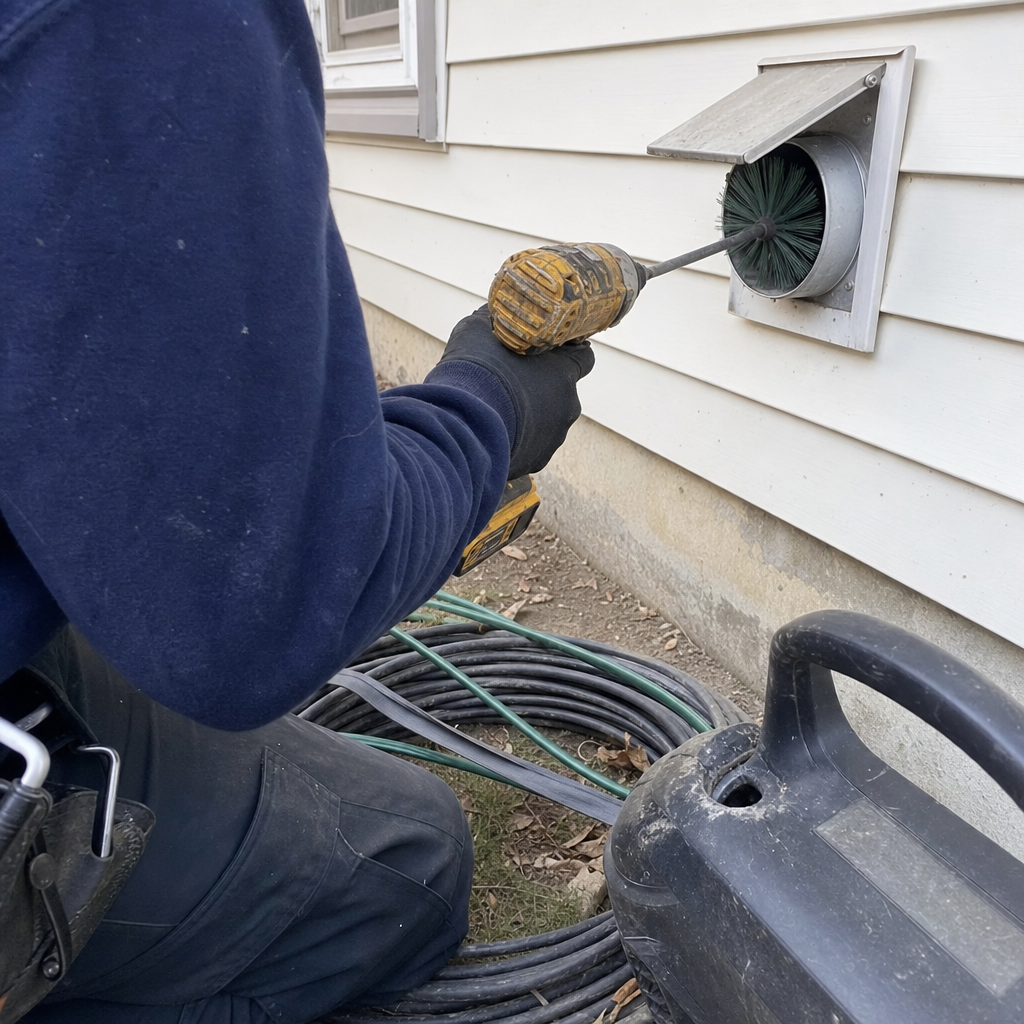
Our process addresses this specifically. We use professional-grade Rotobrush and Nikro duct-cleaning systems — not hardware-store vacuums or rental machines — with agitation tools designed for the irregular, often oversized metal trunks left over from octopus-furnace conversions. For sanitizing, we use Guardsman-brand products with documented efficacy. Matthew handles every job personally, and he’ll show you the before-and-after airflow numbers so you’re not taking anyone’s word for it.
What Professional Dryer Vent Cleaning Actually Involves — and What It Costs
We’re straightforward about this because we want you to know what you’re paying for and why it matters. If you’re wondering how much dryer vent cleaning costs in Akron, OH, here’s how we structure it: A proper dryer vent cleaning on a long interior run isn’t a quick vacuum job. Here’s how we structure it:
| Service Component | What We Do | Typical Range in Akron |
|---|---|---|
| Initial airflow assessment | Digital manometer reading at exterior termination; photo documentation | Included in service call |
| Interior vent cleaning (straight run under 10 ft) | Rotobrush agitation and high-velocity extraction | $129 – $179 |
| Interior vent cleaning (long run with multiple elbows) | Segmented cleaning at each junction, camera inspection if needed, re-measurement | $189 – $279 |
| Transition hose replacement (if cracked or improper material) | UL-listed flexible metal hose, proper clamping | $35 – $65 |
| Exterior cap repair/replacement | Proper flap-style or louvered cap with pest guard | $45 – $85 |
Most Akron homes with standard long interior runs fall in the $189–$229 range for complete cleaning. We don’t quote over the phone for these because the actual configuration — number of elbows, accessibility, condition of existing materials — changes the scope significantly. What we will do is come out, assess at no charge, and give you a firm number before any work starts. I’ll tell you if it needs cleaning. I’ll also tell you if it doesn’t — that’s just how I’d want someone working in my house.
How Akron’s Climate Makes Dryer Vent Maintenance More Urgent
Akron’s position in Lake Erie’s snowbelt means our heating season runs longer and harder than inland Ohio cities. Furnaces operate more, indoor air stays drier, static electricity increases — and lint becomes more combustible in dry winter conditions. Meanwhile, our humid summers create condensation inside exterior vent caps and at elbow junctions, where moist lint compacts into dense, adhesive blockages that don’t shake loose easily.
This seasonal cycling — dry compression in winter, moist adhesion in summer — creates a unique buildup pattern in long interior runs. We’ve found that vents in Akron’s older homes often need cleaning more frequently than the annual recommendation you see in generic guidelines, especially if the home has pets, if the dryer sees heavy use from a large family, or if the vent configuration was never optimal to begin with.
Our Dryer Vent Cleaning service includes a full-system inspection: we check the transition hose behind the dryer (often the crimp point), evaluate the routing for code compliance, and flag any materials that should be replaced — like the white vinyl flex hose that’s a known fire hazard and that we still encounter in older Akron homes.
FAQs
The only definitive way is measured airflow at the exterior termination — visual checks and “feel tests” are unreliable, especially in Akron’s older homes with long interior runs. If your vent has multiple elbows, runs more than 15 feet, or was added to existing construction rather than built with the home, routing is likely contributing to the problem even if it’s not fully clogged. We assess both factors during our free estimate — call (866) 970-8150 to schedule.
DIY cleaning with a brush kit from a hardware store typically costs $20–$40, but it’s rarely effective on long interior runs with multiple elbows — the brush either gets stuck at the first bend or punches through without actually removing compacted lint. For affordable dryer vent cleaning in Akron, OH, professional service with proper agitation equipment and airflow verification runs $129–$279, and it’s the only approach that gives you a measurable, documented result. For the fire-risk homes common in our older neighborhoods, the professional route is the one that actually solves the problem. Call us for an exact quote — estimates are free.
For standard short-run vents, the NFPA recommends annual inspection and cleaning as needed. In Akron’s 1920s–1940s housing stock with long interior runs, we typically recommend cleaning every 12–18 months for average use, and annually for heavy-use households or homes with pets. The specific configuration matters more than the calendar — a 22-foot run with three elbows in a Firestone Park two-story accumulates restriction faster than a straight 8-foot run in a newer Green subdivision. We note your configuration and recommend a schedule after the first cleaning.
We often can, especially for standard configurations in Akron, Cuyahoga Falls, and surrounding areas. Same-day service depends on routing and current schedule — call (866) 970-8150 and we’ll let you know what’s available. Emergency situations (burning smell, dryer overheating, visible smoke) get priority scheduling.
What to Expect When Elite Handles Your Dryer Vent
Matthew arrives as the lead technician, not a dispatched crew member. He’ll walk the vent path with you, explain what he’s seeing, and run that initial airflow measurement before any work begins. The cleaning itself uses Rotobrush or Nikro equipment matched to your duct size and material — flexible tools for the bends, more aggressive agitation for the straight sections where compacted buildup sits. We photograph the condition where accessible, and we re-measure airflow after cleaning so you have before-and-after numbers, not just our word.
If we find improper materials — vinyl flex hose, damaged elbows, an exterior cap that’s missing its flap — we’ll flag it and quote replacement separately. No surprises, no pressure. Our 387 verified reviews averaging 4.9 stars reflect this approach: we’re straight with you about what needs doing, what doesn’t, and why.
We’ve built our reputation across Greater Akron on exactly this specificity. Whether we’re working inside a century-old Craftsman near Highland Square or a post-war ranch on the west side, the standard is the same: measure, document, clean, verify. The homes change; the process doesn’t.
If you’d rather have it looked at than keep guessing, Elite Air Duct Cleaning Service Greater Akron — rated the best dryer vent cleaning in Akron, OH — offers a no-pressure assessment anywhere in Akron — call (866) 970-8150 for a free estimate and same-week scheduling.
Written by Matthew Gonzalez, Owner & Lead Technician at Elite Air Duct Cleaning Service Greater Akron, serving Akron, OH.